We Belong : Project proposal and research
Proposal: We Belong: a peer-to-peer support group for families whose children are struggling in school
“It just – it just means so much to know that there’s other people there that are in your situation and you’re not alone. And that if you need someone you can reach out and they will be there for you, and you don’t have to go through things alone and there is light at the of the tunnel.” https://www.charliewaller.org/parent-carer-peer-support
- Overview: the project
This project aims to encourage parents and carers of children who are struggling with school to regain a sense of confidence and agency and to feel empowered to support their children’s education. It is based on the Anna Freud Pears Family School model and adopts a peer-to-peer model of support. Although research is limited, systematic reviews of peer-to-peer models have found them to be effective in a range of settings, helping reduce distress and improving the well-being and quality of life among parents of children with disabilities.[1] Other research findings include improved quality of life, increased self-esteem, and enhanced social skills, and reducing social isolation and promoting recovery and wellbeing.[2]
The project is based on the principle of Fonagy and Bateman’s mentalization theory which has been further adapted by colleagues Fuggle and Bevington at the Anna Freud Centre to embrace the importance of the wider social system around the individual and the role supportive peers can offer to develop epistemic trust.
Parents and carers will be encouraged to talk about their own experiences openly and honestly and to support each other and to validate the experiences of peers. The sessions will be facilitated by parents and carers who have similar experiences to the attendees. Facilitation will include support from trained parents from the Anna Freud Pears Family School.
Each weekly session will be divided into two main sections – first sharing, followed by learning:
- Sharing will aim to build trust and confidence, with facilitators leading through their own vulnerabilities allowing parents and carers to express their feelings in order to encourage openness and trust and to allow them to validate the experiences of parents. By doing so the group will aim to build strong relationships where previously parents and carers may have felt isolated.
Through this process we will build confidence in a strength-based approach in which attendees will have a better understanding of their strengths, but also to acknowledge where support is needed.
- Learning: the second part of the session will focus more on a more formal learning process – in which time is given over to discuss specific issues that the group will decide they wish to address. This may include sessions on, for example, building and maintaining relationships; neurodiversity; managing emotions (either at home or at school); learning from reflection. However, these topics will be guided by the group. Links to resources will be shared at the end of the session and each session will be followed up with some learning notes as aide memoires.
The outcomes for parents and carers will be measured by an evaluation. These will evaluate:
- Improvements in wellbeing
- Self confidence in supporting their children
- Improved understanding or being better informed about specific areas
- Reduced sense of isolation
- Better relationships with the school
The wider purpose of this project is to identify whether supporting parents in this way can have a longer-term impact on improving the educational experience of children and young people who find school an alienating experience. If the project is successful, I will explore scaling the model up with the London Borough of Hackney, who are supportive and involved in this project.
The project supports Hackney’s current strategic plan and by focusing on early intervention, aims to cut costs – both human and financial – to parents, schools and wider society.
- Introduction
This is a pilot project proposal which aims to provide a supportive environment to empower parents and carers whose children are struggling at school.
The project aims to support parents whose children have difficulty attending school, whatever the cause, and to support their child’s wellbeing and education. It has been developed with the support and input of the founders of the internationally renowned Anna Freud Pears Family School[3] and is based on validating and empowering families. The project takes a strength-based approach to families, identifying them as the source of the solution, rather than a source of blame. It draws on resources from the Harvard University for the Centre of the Developing Child, London Borough of Sutton and Charlie Waller. All findings and interventions are evidence based.
The project is based on scientific evidence, best practice. It is designed to meet the rapidly increasing need to support families whose children are unhappy at school and are at the risk of being excluded from education because they are unable to comply with school requirements. This project will be designed and run by parents who have experience of their children being unable to attend school.
- Why it’s important
In recent years school attendance has emerged as a key issue in education policy. Since Covid absenteeism has increased exponentially. Although there are signs that absenteeism is falling from its peak in general, absenteeism for children who are severely absent (missing more than 50% of school session) is continuing to increase at an alarming rate.
At the same time exclusions are also increasing at an unforeseen rate. This is true for suspensions and permanent exclusions, which are now at the highest level for ten years. Hackney has a particularly high level of exclusions in secondary schools. According to the Education Policy Institute, around 400,000 children were not in school in 2023, an increase of over 53 per cent from 2017. We have also seen a huge increase in elective home education, yet as many as 75% parents or carers. didn’t choose home education, according to the Centre for Young Lives). We know also that exclusions are higher in academies. Research last week from FFT Database show that the number of girls feeling ‘very safe’ in school has plummeted.
These data lend force to an argument that the increasing levels of long-term absenteeism represent a crisis of education with schools becoming less inclusive as demands for additional support rises and schools strive to meet key targets on attainment and attendance. This project aims to provide support to parents and carers to engage constructively with the school at a time of high stress. It also aims to share learning with the school to better understand the reasons why children are unable to attend school and engage and learn from parents to become more inclusive. The evidence shows that many children who are at risk of non-attendance are neurodivergent and a high proportion are on free school meals. By sharing their experience of the education system, we hope the project will encourage more inclusivity.
This proposal starts from the premise that every child has a right to education, but also that a child’s wellbeing is prior to their education, that their education is prior to school attendance and that while school is the best place for most children, their wellbeing should be considered above any other need. It also recognises that a positive relationship between parent and school can only help increase the chances of a child thriving at school.
National figures and figures from The London Borough of Hackney show that a disproportionate number of children who miss school for significant periods have special educational needs. Children from Afro-Caribbean ethnic backgrounds or mixed race are at a far higher risk of exclusion.
Some of these structural issues have been identified and monitored for many years although apparently with little impact on exclusions and absenteeism. More recently concerns have been raised about Emotionally Based School Non-Attendance (EBSNA). In the past this has been characterised sometimes as truancy or school avoidance but a growing body of research has identified that a high proportion of children who experience EBSNA suffer clinical levels of anxiety and are often autistic or have other neurodivergent conditions such as ADHD, sometimes concurrently.
In 2023 I carried out a survey of 55 parents who had experienced EBSNA on behalf of Hackney Independent Parents and Carers (HiP) – the then parent-carer forum for Hackney. The final report was shared widely with officers and councillors in Hackney and in May 2024 the council held a commission of inquiry into the issue. The report from this enquiry is expected to be published shortly.
One of the consistent challenges that has been identified in exclusions and absenteeism is the degree of stress and anxiety parents and carers feel when their child is struggling at school. This can lead to tensions with the school which can undermine attempts for the school and parents and carers to work creatively together to resolve the challenges the pupil is facing. When this tension spills over into conflict, the opportunities for supporting a child vanish.
Parents often feel that the school doesn’t understand them or the needs of their child. This proposal is aimed to support parents and carers and support them at a vulnerable time in their relationship with their child’s school so that both parties can focus on how they can work together to support the needs of the child.
- The evidence
This proposal is based on evidence from research which finds that the impact of absenteeism – or school non-attendance – on family life is corrosive and leads to increased tension within the family. Children pick up on this and the negative thoughts that they have about their inability to go to school and internalise this stress, making return to school more difficult.
One of the reasons parents feel under such stress is that they feel they are not heard. In the HiP Hackney survey, in which families were asked about their child’s EBSNA, parents felt dismissed by School. Responding to the statement that ‘the school listened to my child’s concerns’ 38% answered ‘not at all’; responding to the statement ‘I felt my input was valued’ 37% of parents responded ‘not at all’. Parents gave the school the highest rating in response to the statement ‘the school listened to my concerns’ with only 25% of them giving the school a top mark of 5.
When asked about their relationship with the school the most common experience was of feeling blamed, being judged and being ignored. Families in the survey said they identified two-and-a-half times as many symptoms of distress than the schools did. This is not surprising given that a teacher has to attend to 30 odd children, but it demonstrates that it is important to listen to families to fully understand the behaviour of a child. This is particularly true of children who ‘mask’ or ‘camouflage’ their behaviour at school, which results in overwhelming stress which is released at home in the form of anger, violence, depression and self-harm.
Findings about the relationships between parents and school when a child struggles in the school environment are replicated elsewhere.
A survey carried out by SEN magazine of 224 parents and carers and 25 autistic people who had experienced EBSA/School Distress either as a parent or carer, or a pupil found that 29.8% of schools or professionals considered overprotective parenting a factor in non-attendance compared to just 0.81% of autistic people and their parent/carers.[4] Mullally et al explored the impact of school distress on 1121 participants, including parents of CYP who were currently experiencing distress (n=738), parents of those who had previously experienced it (n=209), parents of those without school attendance difficulties (n=149) and parents of CYP who had never attended (electively home educated, or EHE. N=25).[5] 75% of parents with EBSA or school distress experience reported feeling like they had not been believed by school staff when raising concerns about their child and that they were not believed. A similar number of parents said they experienced being manipulated into doubting their perceptions, experiences or understanding of events.
The Australian School Can’t survey found that their child’s EBSNA impacted on their parent’s employment leading them to work fewer hours or being unable to work for a period. 30% unable to work for a period, 28% took unpaid leave and 20% resigned from their employment.[6] The same study found that two thirds said EBSNA/school distress had an impact on their relationships with their partners (19.7% said this question was not applicable, presumably because they were singe parents or carers) while 95% said having a child with EBSA/school distress had negative impact on their mental health.
This project focuses on supporting parents and carers. But it also acknowledges the research carried out by teaching unions and support charities which identify the stresses and heavy workload that school staff experience. One of the benefits this project will hope to achieve is a reduction the work-load and stresses to staff which is inevitably caused by an escalation of conflict between parent or carer and school.
In addition the proposal will be informed by practiced developed by Anna Freud’s Pears Family Schools, whose founders have lent their support to the project. The process will be based on scientific understanding of the neurological impact that distressed that accompanies school absence has on both parents and carers. It will provide tools to help parents and carers to support their children and help resolve problems this distress can cause.
- Stakeholders
The key stakeholders are as follows:
| Stakeholder | How they will be engaged |
| Children and young people | Although the key benefit is for children and young people, they will not be directly engaged. Instead, the project will engage their parents/carers to give them confidence to support them in the school, and to share learning with the school so that their needs are better understood. The project will also aim to reduce stress at home which contributes to the stress children feel and their shame and feeling responsible for their parents’ stress. |
| Parents and carers | Parents and carers will be engaged through the project, attending weekly sessions. Moreover, we will explore sharing the findings of the project with parent groups including the Hackney SEND parent carer forum, depending on the outcome of the pilot. Parents and carers will benefit from increased confidence, better relationship with the school; reduced stressed at home; and hopefully better outcomes for their child(ren). |
| Schools | The school will be recruited through the local authority and will have responsibility for recruiting parents, to a brief set out by the project. The school will benefit by: Learning how to better support this cohort of parentsHaving a better understanding of the reasons and causes which contribute to children’s absenceLearning how to work more closely with parentsBetter recognition of the individual strengths of parents and carers (taking a strength-based approach rather than using a deficit model) and recognising the benefits this brings. Having additional resource to support familiesPotentially reducing non-attendance (although this may be difficult to show in a short project)Reducing exclusion (although, as above, this may be difficult to show directly in a short project) |
| Local authority | Hackney Local Authority is drawing up a new strategy and one of its priorities is to reduce exclusion. It is also exploring how to better engage parents and carers. As the Vice Chair of Hackney SEND Parent Carer forum, I am already involved in this work. I am currently working with Nicky Pailing, head of the Schools Attendance Support Team (SAST) and various others on emotionally based school avoidance pilots, exclusion and its new alternative learning provision. The local authority is interested in this project and I would share the evaluation at the end of the pilot so the LA could explore future support. My work with the LA through the PCF also means I have connections with health, education and social care. |
| Health | As above. I would distribute findings with CAMHS and others to explore how children can be better supported by providing support for parents. One issue that I’m concerned about is that absenteeism can sometimes lead to a rapidly escalating intervention through MATs which can be confusing and intimidating. The aim of the project is to support early intervention and empower parents before the issue escalates. When escalation occurs, it is often based on the assumption that a family is in need of an intervention rather than able to resolve problems on their own. The impact is reduced agency for parents, increased authority of institutions and a spiralling approach than can leave parents powerless. Of course, it is recognised that escalation is sometimes necessary. |
| Social care | As above – through my attendance on Hackney LA groups I would distribute findings of the project. |
- The aims of the project
- To offer support to parents and carers and the validate their experiences
- To alleviate pressure on parents and carers and in doing so alleviate some of the pressures and the anxiety that children feel.
- By doing this the project will aim to build a stronger relationship with a school and a sense of ‘belonging’ with the school and with that greater engagement
- To help the school understand the experiences of parents and carers, and in doing so help manage the challenges that can result in poor attendance, estrangement from school, or exclusion
- Build up an equal, supportive partnership between school and parents/carers and in doing so build up a holistic and shared understanding of a child’s experience.
- To add capacity to schools by reducing the work that comes with conflict between parents and school and to use the positive energy of parents to problem solve.
- To reduce school absence and improve participation in education for pupils.
- To help schools respond to the needs of vulnerable pupils.
- The approach
Peer to Peer support for families is an integral part of the Anna Freud’s innovative Pears Family School (PFS). This project has been drawn up with input and advice from their founders, Brenda McHugh and Neil Dawson.
This project would draw on their learning and would include contributions from families who have been supported by the school.
Following the PFS model, there would be three elements to the programme:
- Rebuild
- Recovery
- Reintegrate
The project would be parent led, but with the support and commitment of the school. Written into the project is the process of learning for families and the school. The first part of the project would be based on rebuilding parental confidence and validating their experiences.
Rebuilding would focus on how parents can help rebuild executive functioning. The executive functions work is based on the gap in the skills set that adults with mental health problems have, where they have insufficient capacity. These may include helping working memory, common for children with anxiety, managing emotional feelings, planning and prioritising.
The aim of the parent work is ‘de-isolation’ where parents are blamed, blocked and disbelieved. Diminishing parent’s expertise gets in the way of parent partnership and prevents supporting the child into success.
Resources include those provided by Harvard University’s Centre of the Developing Child and provide a handout for parents which includes games they can play with children to improve executive functioning.
- The format
This project is based on having eight one-week sessions, each of one and a half hours for 8-10 parents or carers. The format will be based around supportive discussions to validate people’s experience and develop trust, as well as discussions around topics for learning.
Attendees will comprise:
- 8-10 parents whose children have difficulty attending school
- 2-4 facilitators drawn from parents with experience of school attendance difficulties (The Pears Family School has volunteered their parent group)
- From time to time, one outside presenter.
The aim is to generate a supportive atmosphere to develop warmth and respect. Refreshments will be provide and the initial focus would be on building trust to gain the trust of parents and support them to trust each other and school staff. The main purpose is to build warmth and the role of the facilitator is to ensure that parents feel heard.
“The child learns from parents – one parent said how they hadn’t realised that their child had learned to trust the school when they noticed their parent trusting the school.”
Brenda McHugh OBE, Founder of Pears Family School.
The sessions will follow a simple timetable as follows:
| Time | Topic | Purpose |
| 30 minutes | Welcome and share and discussion | Each person will take turns in sharing to give them a chance to offload, build trust and feel validated; to ensure that the group develops a strong bond. The facilitator will support them by summarising and validating their experiences by connecting with them and saying: ‘have I got this right? Let me know, I think you said …” and at the end “is there anything else you wanted to add…” |
| 20 minutes | Presentation on theme of interest | To help families with resources and demonstrate how they can be used to benefit their children. For the first groups these will subjects will be decided, but once the group gains confidence, they will identify topics of interest. |
| 30 | Discussion on presentations | Discussion based on the presentation and how people can apply them in their own home |
| 10 | Summing up | Reviewing the learning; reminding of key points; cementing the trust; welcoming people for the following week. |
The project would draw on parents from a single school. This would help feedback to the school some of the issues raised, help parents support each other and make it easier for them to travel to a venue close by.
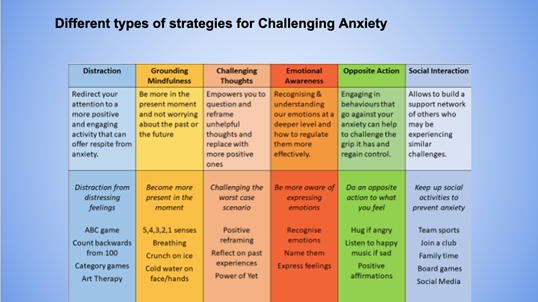
The programme would be developed in consultation with the school. The topics for discussion would be chosen by parents. They could include, for example, presentations on anxiety aimed at building confidence, such as:
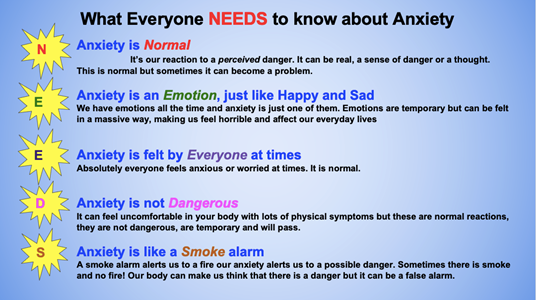
Slides courtesy of Sutton Tuition and Re-integration Services (STARS)
[1] Effectiveness of peer support programmes for improving well-being and quality of life in parents/carers of children with disability or chronic illness: A systematic review https://onlinelibrary.wiley.com/doi/10.1111/cch.13063
[2] NHS England https://www.england.nhs.uk/long-read/peer-support/#:~:text=Peer%20support%20develops%20people’s%20knowledge,support%20and%20information%20%5B1%5D.
[3] The Pears Family School an innovated was founded by charity Anna Freud. Practice has been widely adopted in Germany and Denmark and has been the subject of DfE pilots to help spread its learning across England.
[4] Kat Williams. Non-attendance of autistic pupils and trauma. SEN. Jan 1st 2022. https://senmagazine.co.uk/autism/15226/non-attendance-of-autistic-pupils-and-trauma/#:~:text=Only%207.35%25%20of%20schools%2Fprofessionals,professionals%20within%20the%20education%20system.
[5] Connnolly S. E., Mullaly, S. L. School distress in UK school children: Parental lived experience. Preprint and not peer reviewed https://www.medrxiv.org/content/10.1101/2023.02.16.23286034v1
[6] Parent perspectives on school can’t: implications for health, welfare, disability and education. A submission to the 2022 Federal Senate Inquiry into School Refusal Louise Rogers, Tiffany Westphal. School Can’t. Australia https://t.co/gOVxihFT2M
Other organisations to draw on for expert resources include:
- Great Ormond Street: eg https://www.youtube.com/watch?v=ZKmpa3741CA
- National Autistic Society on masking https://www.youtube.com/watch?v=KZLY-s_Iwu0
- National Autistic Society on overload https://www.youtube.com/watch?v=sMn2o9EYa08
- National Autistic Society: What will happen in an autism assessment https://www.youtube.com/watch?v=lyaCl3qUo3k
- Anna Freud on EBSNA https://www.annafreud.org/resources/schools-and-colleges/school-attendance-and-mental-wellbeing/
- National Trauma Council: Childhood trauma and the brain https://www.annafreud.org/get-involved/networks/uk-trauma-council/
- National Trauma Council: How the brain adapts to adversity
- National Centre for Mental Health Introduction to ADHD https://www.youtube.com/watch?v=YeamHE6Kank
- Educare: How to support a child with ADHD https://www.youtube.com/watch?v=K-qh4NRdmGU
- Anna Freud on depression in adolescence https://www.annafreud.org/resources/schools-and-colleges/expert-advice-and-guidance-videos-mental-health-in-schools-and-colleges/
- Education Endowment Fund on self-regulation and executive function https://educationendowmentfoundation.org.uk/early-years/evidence-store/self-regulation-and-executive-function?approach=creating-and-navigating-challenge
(Please note: these are examples but resources will be tailored to meet attendees’ needs)
We will encourage new parents to join with a view to making the group self-servicing, in other words, if the project is a success, it will be run by parents who have been on the course.
The course will not aim to meet all needs, but will call on the group as a resource to help and suggest ways forward.
Topics for discussion (to be confirmed):
These topics will be based on research, evidence and resources from highly respected organisation (eg Harvard University Center on the Developing Child.). From time-to-time outside speakers will be invited to join. The costs are outlined in the budget. Sometimes the timetable above may vary to meet the needs of the presenters or requirements of the parents.
- EBSNA
- Executive functioning; what it is, why it’s important and how you can help your child.
- Toxic stress
- Resilience
- Facilitation
To ensure that the project has the best chance of success, a professional facilitator has been identified and will be supported by parents from the Anna Freud Pears Family School and myself, Tim Linehan, a father of a child who experienced emotionally based school non-attendance.
The facilitator identified is Sarah Johnson, a parent of children with SEND who runs Pheonix consulting. She is a published author, having written books supporting parents and teachers on working with children with SEMH and a guide to nurturing behaviour. She is a highly regarded professional and an exceptional speaker and mediator. I previously invited her to run a workshop at a Safaplace conference which I attended. I was hugely impressed by her knowledge, her interpersonal skills, her practical and problem-solving approach and her empathy. I think she will be a great asset.
- Reintegration
This proposal outlines the negative experiences of parents and carers whose children are struggling at school and the impact it has on their own confidence to support their children. The intervention outlines how a peer-to-peer approach can help reduce feelings of isolation (by this I mean feeling that they are the only parent or carer experiencing these problems). As we have seen, systematic review of peer-to-peer support groups, while not conclusive, draw positive conclusions about their benefits. This approach is part of the rebuilding confidence, as outlined above, to rebuild, help recover, and reintegrate themselves and their child(ren) into the education system.
The benefit of such an approach is based on theories of brain plasticity, and theories on supporting family relationships which are in turn influenced by the distress which occurs when a child is struggling in school. For example, the stress on a parent of a child struggling at school has an impact on parental relationships, which the child reads and feels responsible for. This can have a damaging impact on a child’s development and their own trust in adults. As the Harvard Centre on the Developing Child puts it, “by minimizing negative influences in a child’s developmental environment, including toxic stress, and bolstering positive influences, like responsive relationships, we can support healthy brain development and the foundations of lifelong health and well-being.”[1]
- Recruitment
There are two parts to the recruitment. The first part is recruiting an individual school and the second part is recruiting the parents.
- School: I am currently working with Laura Stagg, systems leader in Hackney Education to identify a school in Hackney. The school will be provided with a project brief and an outline of their expectations.
- Parents: recruitment of parents will be carried out by the school with the input of those running the project. An outline of the parental profile will be sent to them. The school will be instructed to identify parents at the start of the 2025 Autumn term with parents recruited by December 2025 to start the course in January 2026.
- Confidentiality and ground rules
Ground rules will be laid down for confidentiality. These are:
- This is a safe place where people can talk about things that are difficult to talk about and where we can all trust each other.
- We promise not to talk about anything that goes on in this room outside it. Not to teachers, school staff or anyone else.
- We ask you to respect confidentiality and not to discuss what people have shared here, either in person or on social media.
- The only exception to this is where it is believed that a child is at risk. If this is believed to be the case, the child’s safety overrules our commitment to confidentiality.
- Sometimes we may talk about things that are triggering – in other words they may be upsetting. That’s fine. But it’s also a safe place, so if your emotions start to make the space feel a little less safe, we may ask you to leave the room so that you can collect yourself and cool off. This isn’t a rebuke. We are working with difficult experiences and they can trigger difficult emotions. So, we accept this but also accept that sometimes our difficult emotions may be difficult for others.
- This needs to be a safe place. We want to make this a safe place where people can
- they can trigger difficult emotions. So we accept this but also accept that sometimes our difficult emotions may be difficult for others.
- Evaluation
An evaluation will be carried out before and after the course to identify some of the following issues (details to be confirmed):
- Levels of self-confidence (before and after)
- Levels of confidence in supporting their child(ren)
- Better understanding of key issues about their child
- Better understanding about how to work with the school
- Questions on validation, being understood, valued and agency
- Timings
Once funding has been sourced, I will work with Laura Stagg, the Hackney systems education leader to identify a school.
The best time to run a pilot would be in the winter term of 2026. This allows a term to work with a school on identifying a date and avoids the summer term when the focus will primarily be on exams.
- Budget:
The budget covers the cost of an expert professional facilitator. I have approached Sarah Johnson who is an expert facilitator, author, consultant and key note speaker on education and SEMH. She is also an expert by experience with children of her own who have additional needs and who have experienced school non-attendance. I invited Sarah to present a workshop at SafaPlace’s annual conference in 2023 where she delivered a powerful and practical workshop. Sarah is approachable, empathic, an excellent communicator. She has written books on SEMH and school behaviour. I have approached her about facilitating these workshops and she has reserved space in her diary.
I would be a joint facilitator on a voluntary basis. In addition, we would draw on parent facilitators from the Anna Freud Pears Family School. Other funding sources
- Funding has been sought from local authority funds but none are available
- A second possible source, a funding stream from the National Lottery Community Fund, has been identified. This would depend on an application by SafaPlace (applications are only accepted from charities).
Thank you for your consideration of this proposal
Tim Linehan February 2025
Updated April 2025
[1] https://developingchild.harvard.edu/key-concept/brain-architecture/